
The Next Democratic President Should Give Up Power
Making sure this never happens again can only start with Democrats.

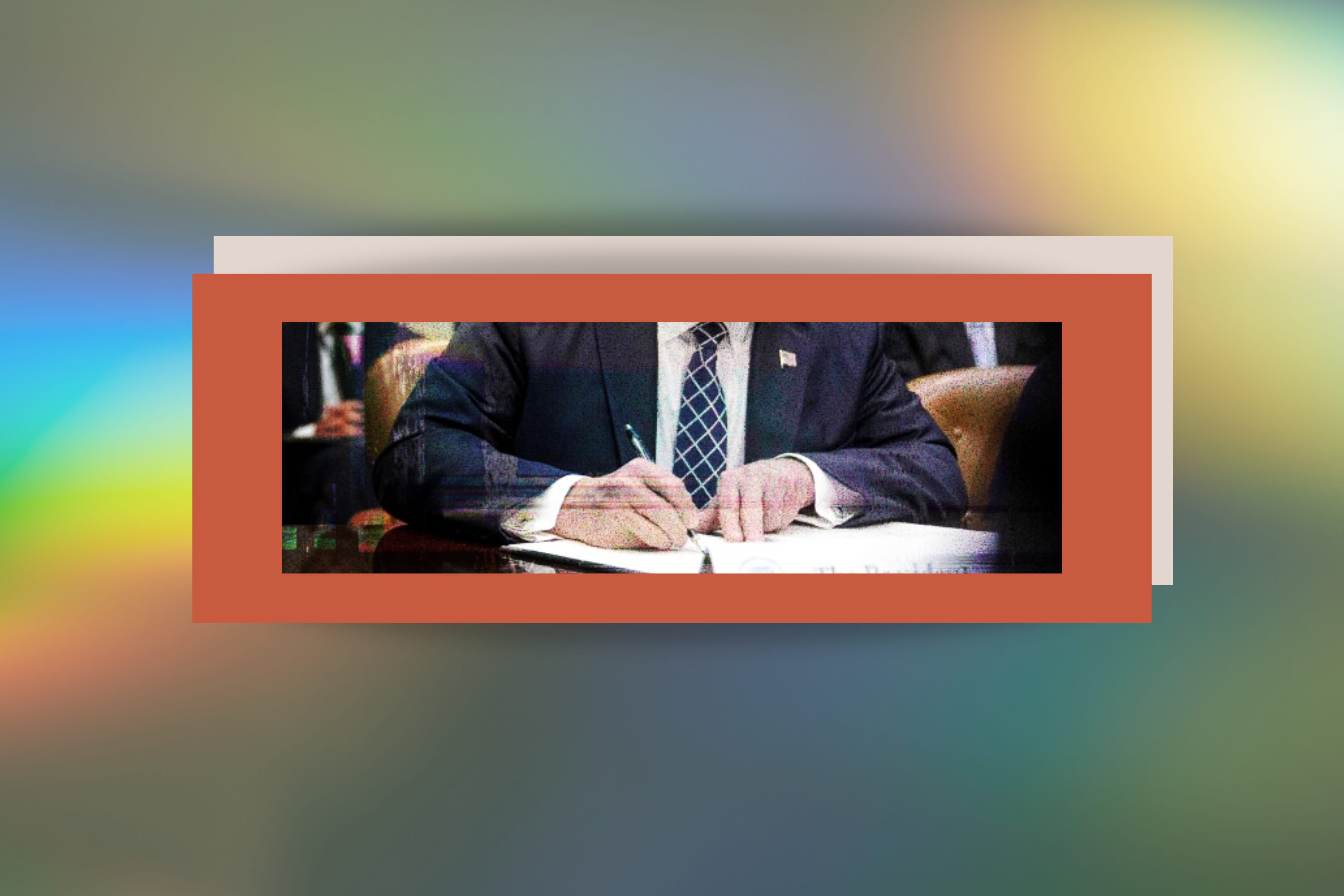
The next Democratic president will face intense pressure from their base to use every available executive tool to enact sweeping change. It’s a vaguely reasonable demand: After years of Republican control, the activist class will argue that Democrats must move quickly and decisively to deliver on the newly elected president’s mandate, and that Congress, with its reputation for gridlock, makes sweeping executive action the only viable path forward. But Democrats should resist this pressure and make the choice that requires overcoming every institutional instinct: voluntarily surrendering power.
Donald Trump has demonstrated the damage that concentrated executive authority can cause when wielded without restraint. He imposed tariffs under fabricated national security pretenses, redirected military construction funds to build his border wall during his first term after Congress explicitly refused to appropriate funds for it, and threatened to withhold disaster aid from states whose governors criticized him. The list goes on. The foundation connecting these actions is not just Trump’s unique character defects. Over the decades, various Congresses, cycling between the parties, have allowed near-unlimited presidential authority to metastasize within the executive branch.
Each successive president inherits this authority. Each president finds reasons to use it. And Americans shouldn’t be resigned to hope that the president wields it at the behest of their own policy preferences.
After two terms of Trump, backed by a Republican Congress willing to defend his repeated constitutional overreach, it is clear that the GOP will not be the party to constrain presidential power. If Democrats believe this represents a real danger – not just a complaint about the opposing party’s agenda – the responsibility falls on Democrats to ensure it doesn’t happen again.
The solution, then, is both simple and Sorkinian: the next Democratic president should make voluntary executive restraint the centerpiece of his or her agenda. It won’t be as easy as just promising not to use the presidency’s vast executive authority this time around. Rather, reform will require both Congress and the president to agree to changes with actual enforcement mechanisms – building constraints that apply in perpetuity.
Presidential humility is popular
Beyond the norms, constraining executive power is good politics for Democrats. A presidential candidate who campaigns on limiting their own authority would tap into public opinion that transcends partisan ID.
Concern over executive overreach typically shifts on the margins with each change in party control – not surprisingly, Republicans disapprove of Democratic executive actions, Democrats disapprove of Republican ones. But polling reveals consistent American disapproval of unilateral presidential power. An AP-NORC poll in March 2024 found that only 21% of Americans thought “the next president should be able to act on important policy issues without the approval of Congress or the courts,” with more Democrats disapproving than Republicans. More current polling shows similar patterns: 51% of Americans believe Trump does too much through executive orders, 56% believe he ignores court orders, and 54% believe he exceeds his presidential authority.
Joe Biden’s 2020 campaign showed that this is popular in practice. Successfully turning the race between two septuagenarians into a referendum on Trump’s first term, Biden promised to restore normalcy and respect institutional boundaries. He won, but in four years of governing, he fell short of instituting reforms to the presidency that would prevent Trump’s excesses again. Coming off Trump’s second term, with even more examples of unchecked presidential power, a Democratic candidate making similar promises could again find receptive voters.
It is hardly surprising that there is cross-partisan appeal to the principle of checks and balances in presidential authority. The extent of the Trump administration’s use of executive authority is unprecedented, but it is hardly just a uniquely Republican phenomenon. Barack Obama used prosecutorial discretion to effectively rewrite immigration enforcement priorities through DAPA and DACA. Joe Biden attempted to “cancel” hundreds of billions in student loan debt through a creative interpretation of the HEROES Act — a 9/11 statute meant to help service members. The motivations vis-à-vis Trump differed dramatically – one involved protecting young immigrants brought to America as children, the other involved economic relief for borrowers – but the underlying mechanisms are identical: a powerful executive making sweeping policy decisions that should require legislative action.
The relatively more altruistic motivations behind Obama and Biden’s executive orders, and their ultimate demise, present another case for reforming executive action: it is a terrible way to effect change.
Executive action is really just not effective
Policies implemented through unilateral presidential authority exist in permanent legal jeopardy, vulnerable to reversal by the next administration and judicial invalidation just as easily as they were signed. Obama’s Clean Power Plan never took effect because it was a presidential regulation rather than a law. DACA has survived multiple legal challenges but still remains in limbo after more than a decade, its beneficiaries unable to plan their lives with certainty because the program lacks permanency. And Biden’s student loan forgiveness was struck down by courts; so too was Biden’s odd attempt to ratify the ERA through executive declaration, which was never taken seriously by the country at large. The examples go on.
Executive actions create the potential for progress while guaranteeing impermanence. They satisfy constituencies in the short term, but they leave beneficiaries vulnerable to the next administration’s reversals.
The advantage of old-school legislative action is that laws passed by Congress are a huge pain to repeal and even more difficult for courts to overturn. The Affordable Care Act is a good example here. Obama had to make significant compromises and water down many of its most ambitious provisions to secure congressional buy-in. But the result is that despite a decade of attempted repeals and successful court challenges against specific provisions, the ACA’s core framework has survived. It withstood a Republican trifecta largely committed to its destruction precisely because undoing legislation requires broad congressional consensus.
Slower progress through legislation beats temporary victories through executive action. Which means the path forward requires accepting short-term policy constraints in exchange for long-term stability.
This is not a call for one-sided disarmament or a naive faith that the other side will follow suit. It is for Democrats to deliver on the promise of reform, prevent Trump’s excesses from ever happening again, and plan to ensure those reforms transcend any future president’s character or ideology.
Reform can’t be just a return norms
Structural reform then requires specific changes – not promises simply to return to the norms of the past – that constrain presidential authority with real enforcement mechanisms. The goal is to return legislative decision-making authority to Congress while preserving presidential authority for situations where it genuinely makes sense.
Trade policy offers perhaps the clearest case for reform because it involves returning authority that the Constitution explicitly grants to Congress. Article I, Section 8 gives Congress the power to “regulate Commerce with foreign Nations” and to “lay and collect...Duties.” For most of American history, Congress set tariff policy through legislation.
But tariff authority moved down Pennsylvania Avenue in the early 20th century. Congress began, slowly, granting the president narrow trade authorities for specific purposes, such as negotiating reciprocal trade agreements, and later for responding to national security threats. The latter, Section 232 of the 1962 Trade Expansion Act, was meant to protect against actual military vulnerabilities in the industrial base, not serve as a general economic tool. But successive administrations expanded these delegations far beyond their original scope. Trump has used Section 232 to place tariffs on virtually the entire world on a variety of goods wholly unrelated to defense – such as timber, wind turbines, and medical equipment.
There is no practical reason that the president needs unilateral tariff authority: it is difficult to imagine an emergency so dire that it must be addressed before Congress can be convened. The next Democratic president should use his or her executive authority to remove all tariffs imposed by presidential authority, and then permanently hand that power back to Congress.
It is unlikely, counterintuitively, that Congress could unify on its own volition to grant itself more authority and pass veto-proof majorities in favor of taking tariff authority away from the president. But the buy-in of a president who specifically wins a mandate to give up this power would be enough to compel Congress to do so.
Tariffs are just one mechanism in which a Democratic president’s buy-in could motivate Congressional action to move power away from the White House:
Create binding restraints on the War Powers Resolution, requiring Congressional approval for military actions beyond a 30-day window; otherwise, funding cuts kick in.
Deter the misuse of clemency and pardons by amending federal bribery and obstruction statutes to explicitly include corrupt pardons, and mandate that the Justice Department automatically release all investigative files related to any pardon issued to a president’s relatives or political allies. Or if we’re feeling ambitious, pass a constitutional amendment to remove the power all together.
Amend the National Emergencies Act to mandate that all presidential emergency declarations automatically expire after 30 days unless explicitly approved by a vote of Congress. There are currently 48 national emergencies in effect – the oldest being declared by President Jimmy Carter in 1979.
Strengthen the Impoundment Control Act to strip the president of the authority to “defer” or “rescind” appropriated funds for policy reasons.
Rewrite the Federal Vacancies Reform Act to drastically shorten the time temporary officials can serve and prohibit the president from firing a confirmed appointee on a whim.
A Congress that has its own agency to enact change — the ability to independently legislate rather than serving as a rubber stamp or obstructionist based on the president’s whims — would reshape how American politics functions in healthier, more democratically accountable ways. Democratic incentives would improve across the board. Individual members would own their votes and be forced to defend them on the merits before constituents, allowing voters to effectively evaluate Congress on its own terms. Elections stop feeling existential because power is dispersed across 535 people rather than concentrated in one office.
Today’s Republican elected representatives have made it clear they will not rein in the unchecked authority of a modern Republican president. They now view expansive presidential power as an unalienable feature of effective Republican governance. That leaves Democrats, who have at least signaled that institutional reform matters, as the only party positioned to act. This isn’t just about constitutional principle or democratic health, though those stakes are real. It’s also practical politics: a Democratic candidate who campaigns on voluntarily limiting presidential authority and promises to usher in reforms that constrain all future presidents, regardless of party, would tap into widespread public exhaustion with executive overreach and four-year policy whiplash. The path to winning might not be promising to wield power more aggressively than the other side, but promising to end the cycle entirely.
I agree with this, but I also think for this to work Congress will need to reform its own procedures to allow it to be more nimble and exercise authority more easily. The big one is eliminating the filibuster, though that on its own won’t be sufficient. You’d also have to have reforms that streamline the committee process, and that takes some power from leadership and committee chairs and gives it to backbenchers. Basically the thought is to make it raise to pass bills, and to give more agency to individual members so that they feel more invested in preserving Congress’ power as an institution.
I think the only way to actually enforce any change is to push control of spending back to the body that authorizes it. We need to make changes to Impoundment rules.
Trump is brazen, shameless, and lawless. He will openly do illegal things, such as not spend money as authorized by Congress, and Congressional Republicans and the Courts don't care. See, e.g., USAID.
Any future president can do the same. The problem with Trump isn't just that the executive has too much power. Its that a President with enough support from his party and within the administration can break the law, and continue with illegal actions, until SCOTUS stops it. By the time SCOTUS steps in, damage will be done.
This must change. We must create bodies that can act independently of the President to execute spending or enforce laws. Who enforces funding cuts under your war powers suggestion? The Treasury? Would Bessent ever enforce that? Doubtful.
The Courts and Congress need an independent enforcement arm to make sure that Presidents can't break laws and get away with it, since the President is supposed to enforce the laws he is breaking. Until that happens, Democrats absolutely should not unilaterally disarm, and should use Trump's shameless tactics to bring Republicans to the negotiating table to make these radical changes.